



Local SEO Maryland: Complete Guide for Small Businesses
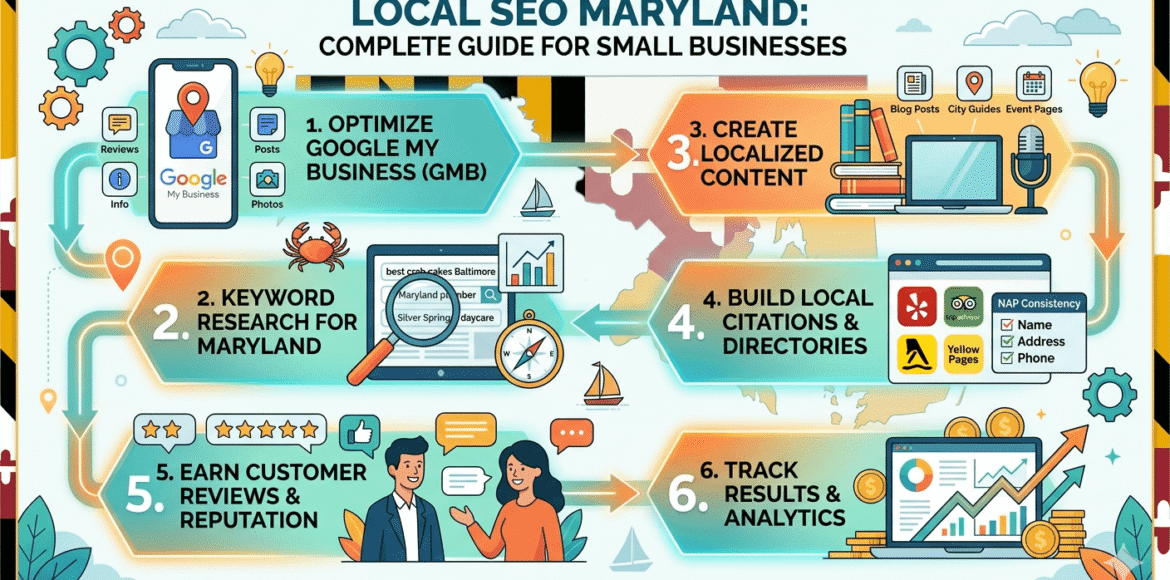
For small businesses across the Old Line State, visibility is everything. Whether you run a law firm in Annapolis, a boutique store in Baltimore, or a roofing company in Rockville, your prospective clients are looking for your services online right now. But if your business doesn’t appear in the top spots of Google’s local search results, you are effectively giving away money to your competitors.
In today’s hyper-competitive digital landscape, relying purely on traditional word-of-mouth marketing isn’t enough. To systematically capture local demand, you need a robust digital framework. That is where local SEO Maryland strategies come into play.
This comprehensive guide breaks down the precise framework required to dominate local search engine result pages (SERPs), outrank your local competition, and turn digital clicks into paying clients.
What is Local SEO and Why Does It Matter for Maryland Businesses?
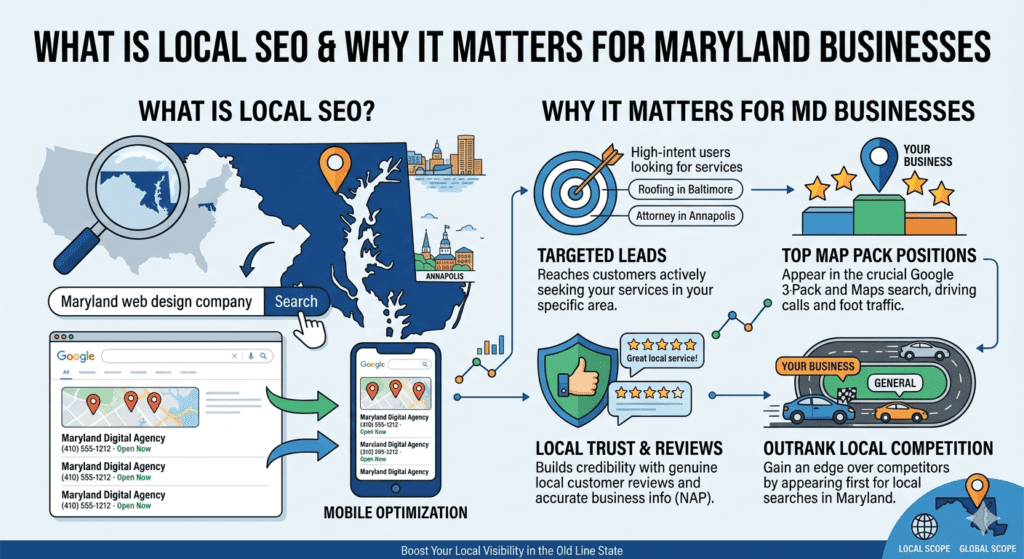
Local search engine optimization (SEO) is the specialized process of optimizing your online presence to attract more business from relevant local searches on Google and other search engines. Unlike standard national SEO, which targets broad keywords without geographic boundaries, local SEO hyper-focuses on the specific physical coordinates and service areas of your enterprise.
When a customer searches for “web development near me” or “emergency plumbing in Maryland,” Google modifies its main algorithm to deliver highly localized results. These results are typically broken down into two distinct areas:
- The Google Local Map Pack (The Map 3-Pack): The map graphic and three business listings that appear at the top of the search engine results page.
- Local Organic Results: The traditional website links that sit directly below the map listings.
Securing a spot in both sections creates an omnipresent footprint. For growing companies looking to build credibility, partnering with an experienced local SEO company Maryland ensures that you don’t miss out on high-intent, immediate buyers who are looking for services in your specific neighborhood.
Master the Pillars of the Google Business Profile (GBP)
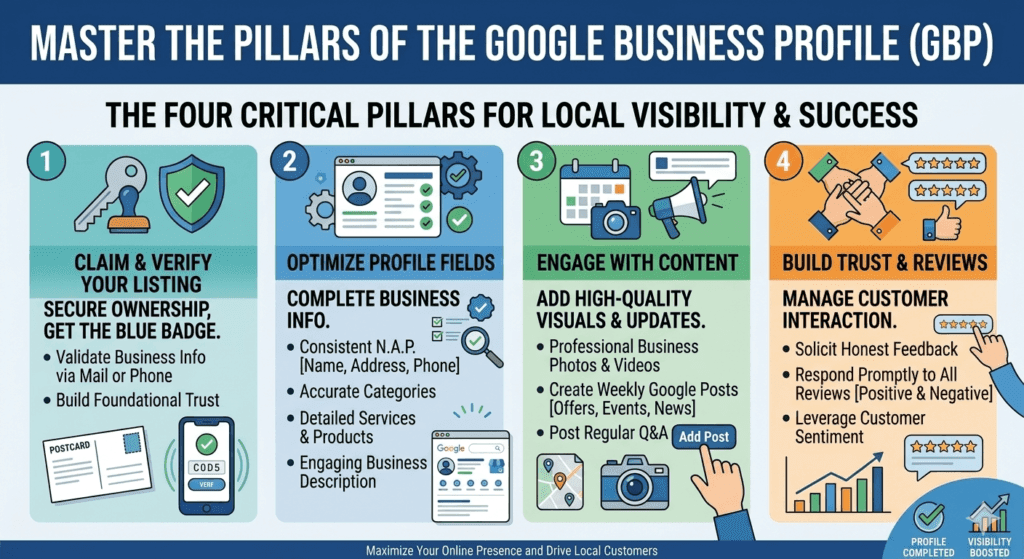
Your Google Business Profile (formerly known as Google My Business) is the absolute nucleus of your local search strategy. It acts as your official digital storefront. Without a verified, properly optimized, and active profile, ranking in the coveted Local Map Pack is practically impossible.
Step-by-Step Optimization Protocol
- Claim and Verify: Visit ://google.com to claim your listing. Complete the verification process immediately via phone, email, or video verification.
- Exact NAP Consistency: Ensure your business name, physical street address, and phone number (NAP) exactly match the information displayed on your main website. Do not stuff keywords into your business name field unless it is your legal name, as this can trigger a swift suspension from Google.
- Primary and Secondary Categories: Your primary category must accurately reflect your core business model. If you run a digital agency, select a primary category like Website Designer or Marketing Agency. Utilize secondary categories to flesh out secondary offers (e.g., Internet Marketing Service).
- Deep Business Description: Write a comprehensive description using up to 750 characters. Use this space to highlight your unique value proposition while weaving in variations of your primary keyword, such as local SEO services Maryland.
- Publish High-Resolution Visuals: Regularly upload real photos of your office, your staff, completed projects, and your physical location. Geotagged, authentic images build unparalleled trust with both users and search bots.
Dominate Local Citations and NAP Consistency
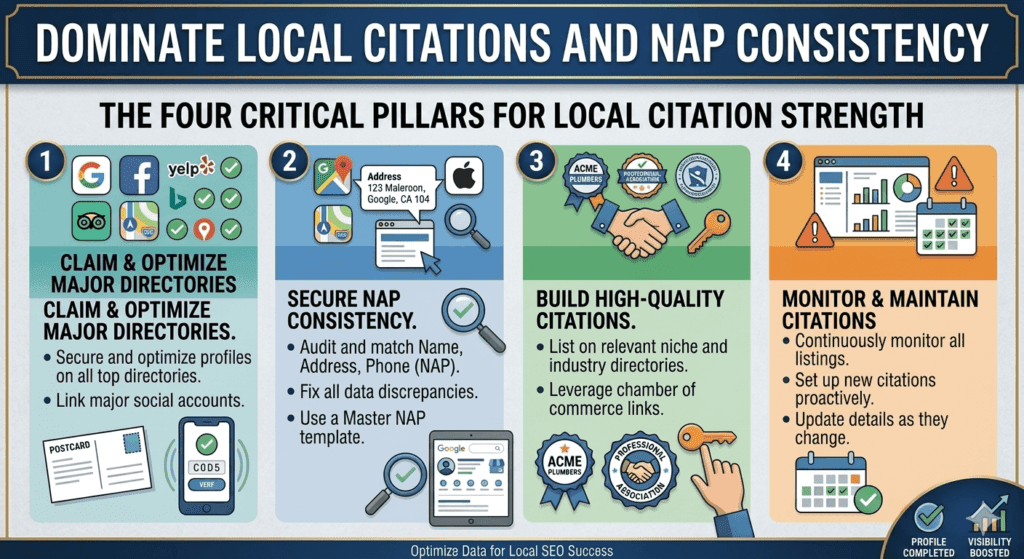
A local citation is any online mention of your company’s name, physical address, and telephone number. Think of citations as digital votes of confidence. The more identical listings you have across authoritative directories, the more confident Google becomes regarding the physical location and legitimacy of your business.
Aggregating High-Value Citations
To establish an unshakeable local foundation, your data needs to be deeply distributed across three core directory tiers:
| Citation Tier | Platform Examples | Execution Method |
| Tier 1: Core Search Engines | Google, Bing Maps, Apple Maps | Manual setup with high visual optimization |
| Tier 2: Major Directories | Yelp, YellowPages, TripAdvisor, Foursquare | Consistency monitoring across every profile |
| Tier 3: Local Hyper-Niche | Maryland Chamber of Commerce, Local B2B hubs | Localized submissions to boost regional authority |
The Danger of Inconsistent Data
If a directory lists your business address as “122 Vanguard Ln, Annapolis, MD 21401” while another lists it as “122 Vanguard Lane, Suite A,” Google’s search bots face a contradiction. This data fragmentation erodes ranking signals. You must systematically audit your digital footprint to wipe out duplicate listings, outdated phone numbers, and misspelled street names.
Scale Authority with Service-Area Pages
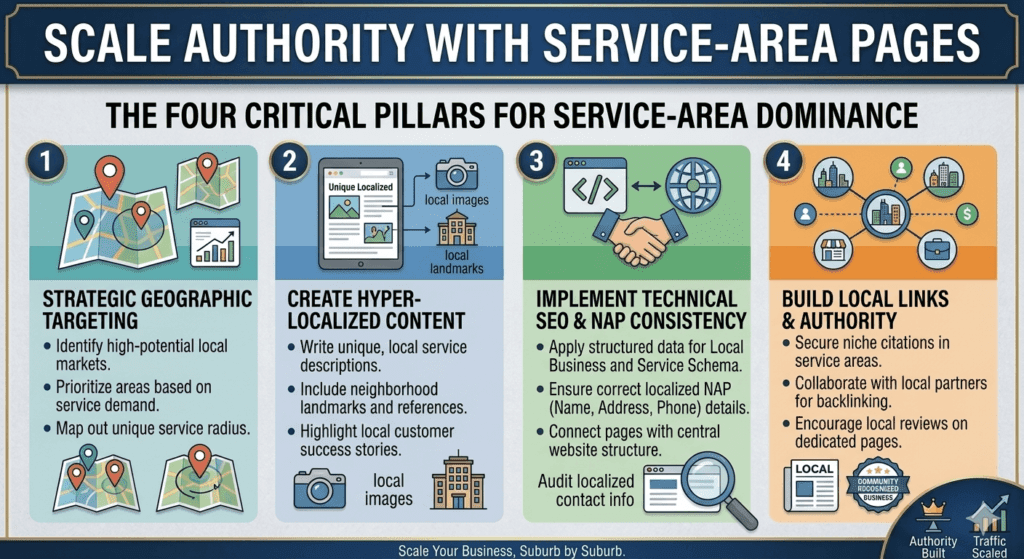
If your small business operates out of a single physical office but services multiple regions or counties across the state, you need dedicated Service-Area Pages. A single homepage cannot rank for every single town in Maryland simultaneously without losing its core topical relevance.
The Blueprint for High-Converting Location Pages
Avoid the common trap of creating cookie-cutter pages where only the city name is changed. Google penalizes thin, programmatic duplicate content. Instead, engineer rich, bespoke experiences for each location:
- Hyper-Local Copy: Mention specific regional landmarks, local neighborhood names, transit hubs, and specific local community challenges.
- Embedded Maps & Coordinates: Embed a custom Google Map pointing directly to your primary location or highlighting the boundaries of your specific service radius.
- Localized Review Social Proof: Feature testimonials and reviews exclusively from customers residing within that specific city or ZIP code.
- Unique Schema Integration: Implement precise structured data markup customized to the specific region target.
By systematically deploying these specialized pages, your brand establishes deep contextual relevance across wider geographic horizons, allowing you to rank effortlessly for competitive keywords like Maryland local SEO company across multiple target zones.
Architecting On-Page Local SEO and Content
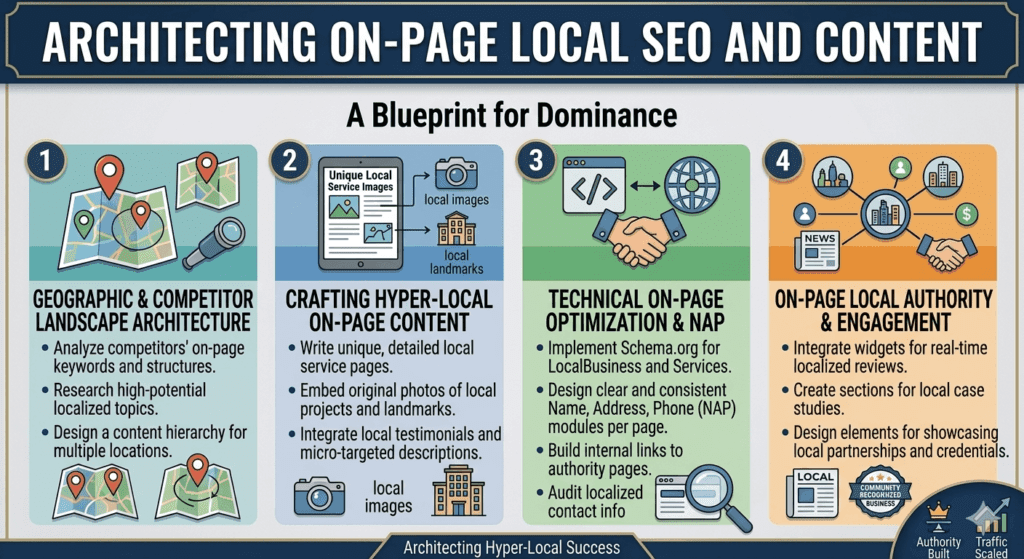
Your on-page architecture tells search engines exactly what service you offer and where you are qualified to perform it. To extract the maximum value out of your website traffic, you must integrate local structural elements cleanly into your website’s underlying code.
Critical Technical On-Page Elements
- Title Tags and Meta Descriptions: Your primary title tag should follow a clean, optimized hierarchy: Core Service – City, State | Brand Name. Keep descriptions under 160 characters and make sure they include actionable calls to action.
- Heading Structures (H1, H2, H3): Your primary H1 must clearly state what you do and where. Utilize H2 and H3 tags to break up content sections covering specific sub-services and local case studies.
- Internal Hyperlink Mapping: Link your informative localized blog posts back to your transactional pillar pages. For instance, if you are writing about regional business visibility, link directly to your core SEO Services page to cleanly distribute page rank authority throughout your website infrastructure.
- Local Business Schema Markup: This structured data code is added to your website backend. It translates your human-readable contact details into a standardized, machine-readable language that Google can crawl instantly, cementing your status as a verified local business.
Review Acquisition and Online Reputation Velocity
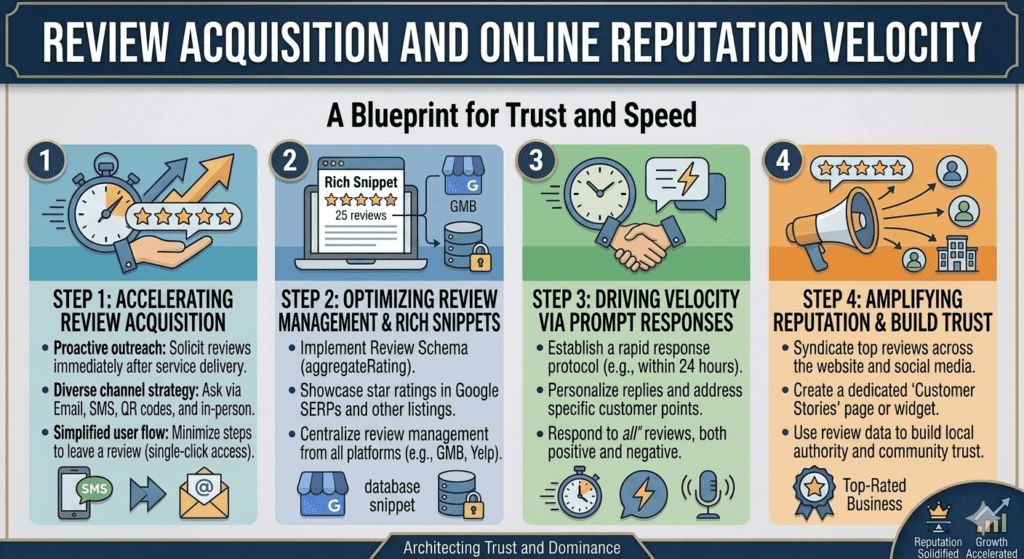
Online reviews are no longer just a superficial trust metric; they are heavily weighted ranking signals inside Google’s core local search algorithm. Google tracks review volume, positive velocity (how frequently you get reviews), and how actively your team responds to user feedback.
High Review Volume + Fast Review Velocity + Positive Sentiment = Rapid Local Map Pack Elevation
Building a Frictionless Review Loop
- Automate the Ask: Integrate a post-purchase automated email or SMS campaign that politely invites customers to share their direct experiences.
- Generate a Direct Review Link: Extract the unique short-link from your Google Business Profile dashboard and turn it into an easy-to-remember redirect link or a highly scannable QR code printed on physical receipts.
- Keyword-Rich Responses: When responding to reviews, naturally include a mention of your service. For example: “Thank you! We love being the go-to web design and local SEO team in Annapolis.” This contextualizes your reviews for search engines.
Tracking, Analysis, and Local KPI Measurement
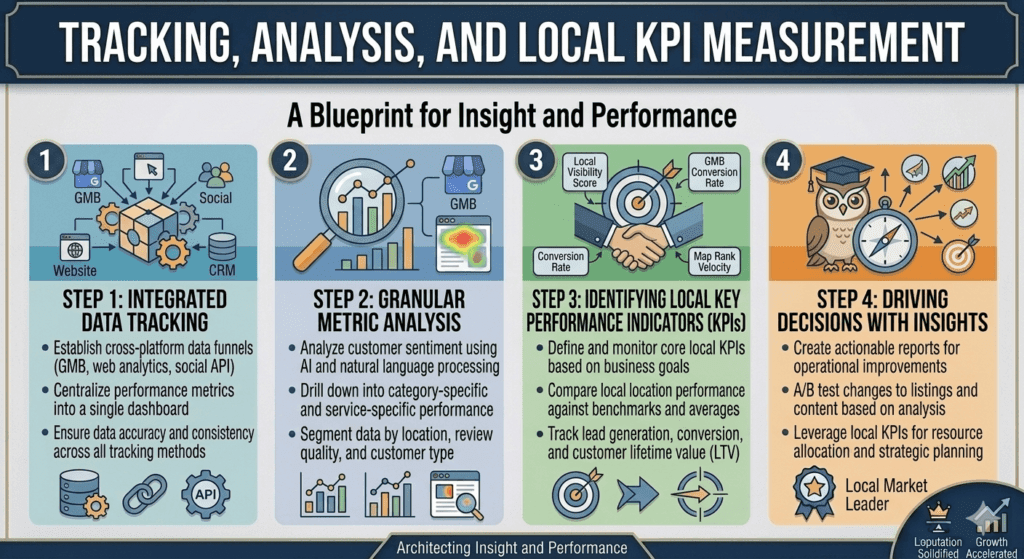
You cannot optimize what you do not accurately measure. To ensure your digital campaigns yield a tangible return on investment, you must set up robust analytics tracking that monitors actual growth over vanity metrics.
Key Performance Indicators (KPIs) to Monitor
- Google Business Profile Insights: Monitor how many users clicked the “Call” button, requested driving directions, or visited your website directly through your local map listing.
- Organic Local Traffic Split: Utilize Google Analytics to isolate and track search engine traffic coming exclusively from users physically located within the state of Maryland.
- Geo-Grid Keyword Ranking: Traditional rank trackers only show a single absolute ranking position. Use geo-grid tracking tools to view your local rankings on a precise grid map, showing exactly how your positions shift block-by-block across a city.
Dominate Local Rankings with Smart Web Designers
Navigating the technical complexities of local algorithms while running a small business can feel overwhelming. If you want to stop guessing and start scaling your organic visibility, partnering with a specialized agency is the fastest path to sustainable revenue growth.
At Smart Web Designers, we specialize in transforming underperforming websites into high-converting, traffic-generating assets. From configuring immaculate Local Business schema to executing flawless on-page optimization, our team knows exactly what it takes to elevate your business on the local stage.
Let Smart Web Designers help you claim your rightful spot at the top of Google. Take the first step toward transforming your online visibility today by exploring our custom SEO Services page or calling our Maryland office directly at (240) 233-6948 to secure a free technical audit!
Frequently Asked Questions (FAQs)
How long does it take to see tangible results from local SEO Maryland strategies?
Typically, small businesses begin noticing measurable improvements in their local organic visibility and Local Map Pack placements within 3 to 6 months. This timeline depends heavily on the historical age of your domain, current local competition density, and how thoroughly your local citations and Google Business Profile are optimized.
Can I rank in the Maryland Local Map Pack if my business doesn’t have a physical store address?
Yes. If your business operates as a Service-Area Business (SAB)—such as a mobile plumber, home contractor, or digital consultant—you can configure your Google Business Profile to hide your residential address. You will define your target regions by entering specific counties, cities, or ZIP codes instead.
What is the difference between organic SEO and local SEO services Maryland?
Traditional organic SEO focuses on optimizing your web pages to rank for informational keywords on a global or national scale, regardless of user location. Conversely, local SEO marketing MD campaigns optimize your digital presence for specific geographic regions, ensuring you connect with nearby users looking to make an immediate local purchase.
Why is my business not showing up in the Google Map Pack even though I’m physically located in Maryland?
This usually happens due to data fragmentation or a lack of local authority signals. Common root causes include incorrect or conflicting NAP data across business directories, a missing Local Business schema markup installation, a lack of consistent customer reviews, or having your profile category set to an incorrect primary industry.
How often should I audit my local citation profiles for errors?
It is highly recommended to run a comprehensive local citation audit at least once every six months. However, if your business goes through a major transition—such as moving to a new office space, changing your primary contact phone number, or updating your official brand name—you must execute an immediate citation audit and update all profiles concurrently.