




Search Engine Optimization vs Search Engine Marketing: What’s the Difference?
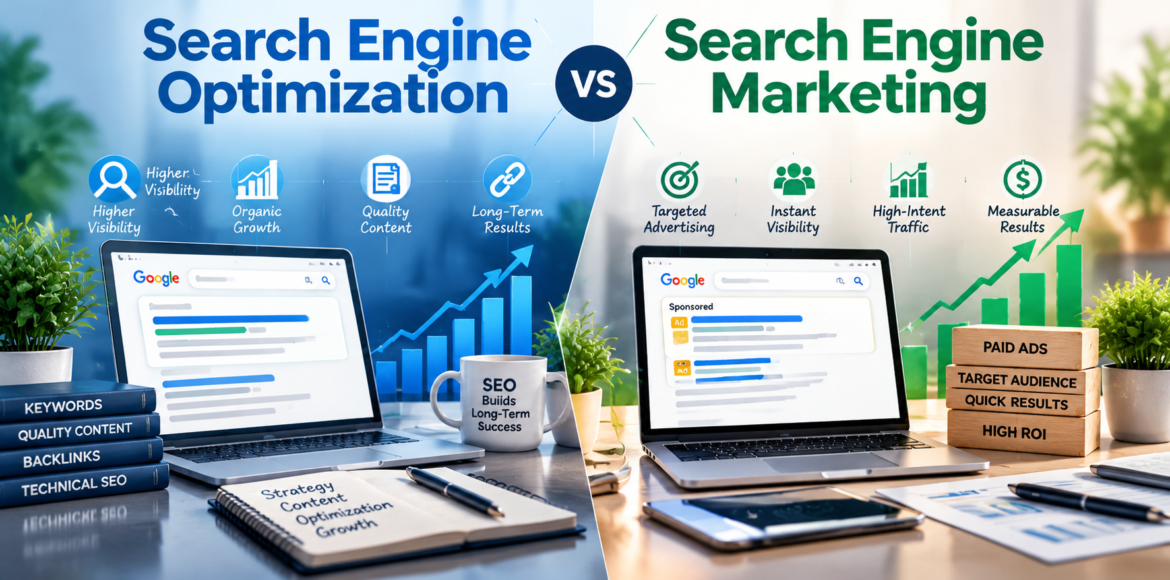
When businesses want to improve their visibility online, two terms often appear together: Search Engine Optimization (SEO) and Search Engine Marketing (SEM).
Although they are closely related, they are not the same strategy.
Many business owners confuse SEO vs SEM because both focus on improving visibility in search engine results pages (SERPs). However, they work in different ways, require different investments, and achieve different goals. SEO focuses primarily on earning visibility through organic search results, while SEM is commonly used to describe paid search advertising strategies that help businesses appear immediately through platforms like Google Ads.
Understanding the difference between search engine optimization vs search engine marketing helps businesses make smarter decisions about where to invest their marketing budget.
Should you focus on building long-term organic visibility with SEO? Should you use paid advertising for immediate traffic? Or should you combine both strategies?
The answer depends on your goals, timeline, competition, and business growth strategy.
What Is Search Engine Optimization (SEO)?
Search Engine Optimization is the process of improving a website so it can achieve higher rankings in organic, non-paid search results.
When someone searches on Google, the results that appear naturally below advertisements are organic results. Businesses earn these positions by improving website quality, relevance, authority, and user experience.
A strong search engine optimization Maryland strategy focuses on helping search engines understand:
- What your business offers
- Which customers you serve
- Why your website deserves visibility
- How your content answers user questions
SEO is not a single action. It is an ongoing process involving technical improvements, content development, keyword research, website optimization, and authority building.
How SEO Works for Businesses
A professional SEO strategy usually includes several important areas.
Technical SEO
Technical SEO focuses on improving the foundation of your website.
This includes:
- Website speed improvements
- Mobile optimization
- Proper indexing
- Website structure
- Schema markup
- Fixing technical errors
A website that search engines can easily crawl and understand has a stronger foundation for ranking.
On-Page SEO
On-page SEO improves the content and structure of individual pages.
This includes optimizing:
- Page titles
- Headings
- Content structure
- Internal links
- Images
- Meta descriptions
The goal is to create pages that satisfy both search engines and users.
Content Strategy
Modern SEO depends heavily on useful, expert-driven content.
Search engines want to provide users with reliable answers, which means businesses need content that demonstrates experience and knowledge.
Examples include:
- Service pages
- Educational blogs
- FAQs
- Industry guides
- Case studies
Quality content helps businesses build topical authority and attract customers throughout different stages of the buying journey.
What Is Search Engine Marketing (SEM)?
Search Engine Marketing is a broader search marketing approach that includes paid search advertising. In many business contexts, SEM commonly refers to paid search campaigns such as Google Ads, where companies pay to display advertisements for specific keywords.
Unlike SEO, where businesses earn rankings over time, SEM allows companies to pay for immediate visibility.
For example, when someone searches:
“web design company Maryland”
the sponsored results appearing at the top of Google are paid search advertisements.
Businesses use SEM to reach customers who are actively searching for specific products or services.
How SEM Works
SEM campaigns typically involve:
Keyword Targeting
Businesses select keywords related to their products or services.
Examples:
- SEO services Maryland
- Website design company
- PPC agency Maryland
Paid Advertising Campaigns
Advertisers create campaigns where they compete for ad placement.
Common platforms include:
- Google Ads
- Microsoft Advertising
Landing Page Optimization
Successful SEM is not only about getting clicks.
The landing page must encourage visitors to take action.
Examples:
- Requesting a quote
- Booking a consultation
- Calling the business
- Completing a purchase
SEO vs SEM: Key Differences Explained
Understanding the difference between SEO and SEM becomes easier when comparing their goals, costs, timelines, and results.
| Factor | SEO | SEM |
| Traffic Type | Organic traffic | Paid traffic |
| Results Speed | Long-term growth | Immediate visibility |
| Cost Model | Investment in optimization and content | Pay-per-click advertising |
| Long-Term Value | Builds lasting search visibility | Stops when advertising stops |
| Best For | Sustainable growth | Immediate leads and campaigns |
SEO vs SEM: Difference in Timeline
One of the biggest differences between SEO and SEM is how quickly results appear.
SEO Timeline
SEO requires patience because search engines need time to evaluate improvements.
The process often includes:
- Website optimization
- Content creation
- Authority building
- Ranking improvements
Depending on competition and website condition, meaningful SEO results may take several months.
However, once strong rankings are achieved, organic traffic can continue generating value without paying for every visitor.
SEM Timeline
SEM provides faster visibility.
Once a campaign is approved and launched, businesses can begin receiving traffic almost immediately.
This makes SEM useful for:
- New product launches
- Promotions
- Seasonal campaigns
- Businesses needing immediate leads
However, traffic depends on continued advertising investment. When the budget stops, paid visibility usually stops as well.
SEO vs SEM: Understanding the Cost Difference
Both SEO and SEM require investment, but the cost structure is different.
SEO Investment
SEO costs usually include:
- Strategy development
- Content creation
- Technical optimization
- Website improvements
- SEO management
The investment builds digital assets that can continue providing value over time.
SEM Investment
SEM requires advertising spend.
Businesses typically pay each time someone clicks their advertisement.
Costs depend on:
- Industry competition
- Keyword demand
- Target location
- Campaign quality
- Conversion rates
For competitive industries, paid search costs can become expensive without proper campaign management.
When Should a Business Choose SEO?
SEO is usually the right choice for businesses looking to build long-term visibility.
SEO works well for companies that want to:
- Increase organic traffic
- Build brand authority
- Reduce dependence on paid ads
- Attract customers searching for solutions
- Create long-term digital growth
For example, a Maryland business competing locally may benefit from a strong SEO services Maryland strategy focused on location-based keywords and valuable content.
When Should a Business Choose SEM?
SEM is valuable when businesses need immediate visibility.
Paid search can be useful for:
- New businesses entering competitive markets
- Limited-time promotions
- Testing new services
- Generating immediate leads
- Targeting high-intent customers
For example, a company launching a new service may use PPC campaigns to quickly reach customers while building SEO momentum.
Should Businesses Use SEO and SEM Together?
For many businesses, the strongest strategy combines both.
SEO and SEM are not competitors.
They support different stages of growth.
A combined approach allows businesses to:
- Generate immediate traffic through paid ads
- Build long-term organic visibility
- Test valuable keywords
- Understand customer behavior
- Improve marketing efficiency
For example:
A business may use PPC advertising to discover which keywords generate conversions. Those insights can then help guide future SEO content strategies.
SEO and SEM for Maryland Businesses
Maryland businesses operate in competitive local markets where online visibility can directly impact customer acquisition.
Whether you are targeting customers in Baltimore, Rockville, Bethesda, Columbia, or other Maryland areas, your search strategy should focus on reaching people with strong buying intent.
A complete search strategy may include:
- Local SEO optimization
- Google Business Profile improvements
- Service page optimization
- Content marketing
- PPC campaign management
Choosing between SEO and SEM depends on your immediate needs and long-term goals.
How to Decide Between SEO and SEM
Ask these questions:
Do you need results immediately?
If yes, SEM may help generate faster visibility.
Are you building long-term growth?
SEO can create lasting organic value.
Is your market highly competitive?
A combination of SEO and paid search may provide stronger coverage.
Do customers research before buying?
SEO can help capture users during their research process.
The best strategy is often not choosing one over the other, but creating a balanced search marketing plan.
Final Thoughts: SEO vs SEM — Which One Is Better?
The answer depends on your business objectives.
SEO builds long-term visibility, authority, and organic traffic.
SEM provides immediate exposure through paid search campaigns.
Neither strategy replaces the other.
Businesses that want sustainable growth often combine both approaches to maximize their presence in search results.
If you want to improve your organic visibility, explore our SEO services Maryland solutions.
If you need immediate traffic through targeted advertising campaigns, learn more about our PPC agency Maryland services.
Frequently Asked Questions
What is the difference between SEO and SEM?
SEO focuses on improving organic search rankings, while SEM commonly refers to paid search advertising strategies that help businesses gain immediate visibility in search results.
Is SEO better than SEM?
Neither is universally better. SEO is valuable for long-term growth, while SEM is useful for businesses that need immediate traffic and targeted visibility.
How long does SEO take compared to SEM?
SEO usually requires months to build results, while SEM can generate visibility shortly after campaigns launch.
Can businesses use SEO and SEM together?
Yes. Many businesses combine SEO and SEM to gain immediate traffic while building long-term organic growth.
Which strategy is better for a small business in Maryland?
Many Maryland small businesses benefit from combining local SEO with targeted PPC campaigns. The right approach depends on competition, budget, goals, and customer behavior.