



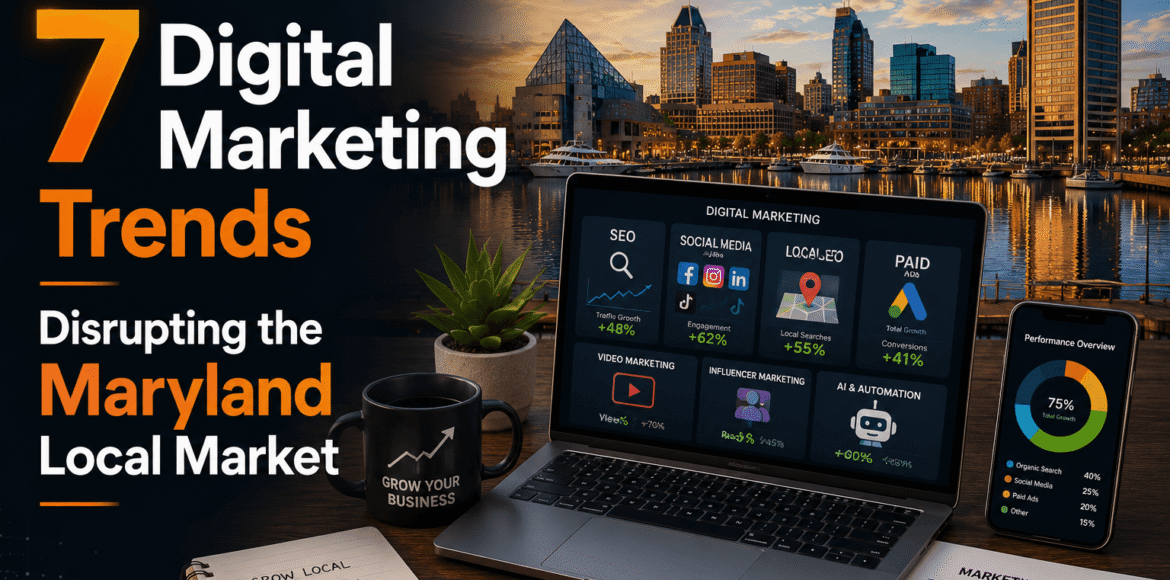
7 Digital Marketing Trends Disrupting the Maryland Local Market
Introduction: The Evolution of Regional Inbound Marketing
Relying entirely on word-of-mouth networks, print flyers, or basic billboard placement no longer sustains local business growth across the Mid-Atlantic. The modern consumers of the Old Line State—whether they are looking for a commercial construction contractor in Baltimore, an IT consultant in Rockville, or a medical clinic in Annapolis—start their buying journeys online. They use highly localized search commands, look for social proof on mobile devices, and filter out untrustworthy corporate entities.
The fast pace of digital change means local marketing playbooks need constant updates. Simply having a basic website sitting quietly on the web is no longer enough to build a reliable client pipeline. To capture and maintain predictable market shares, independent brands must integrate cutting-edge digital marketing agency maryland methodologies into their growth strategies. This guide analyzes the seven major digital marketing trends disrupting local markets and explains how your business can use them to outpace competitors.
[Traditional Outbound Ads] ──> Low Engagement ──> High Customer Acquisition Cost
[Targeted Digital Funnels] ──> High Engagement ──> Lower Customer Acquisition Cost
Trend 1: Hyper-Localized Geo-Fenced Content Architecture
Search algorithms are increasingly favoring localized search intents. Google no longer surfaces general, high-level business pages for users looking for regional providers. The search engines analyze the precise geographic coordinates of the searcher’s device to deliver hyper-targeted results.
Building Regional Content Silos
Generic marketing copy fails to connect with local buyers. To establish authority within your market, you must build out distinct content hubs centered on specific local communities. Instead of targeting broad statewide phrases, your website should feature highly targeted resources that address localized pain points, community regulations, or local architectural and environmental challenges.
Incorporating Multi-Media Formats for Longer Engagement
Plain text blocks struggle to keep consumer attention on mobile screens. Integrating high-quality short explainers, video client testimonials, and interactive project calculators increases user on-page time. This sustained engagement signals strong user satisfaction to search engine crawlers, which helps lift your organic rankings.
Trend 2: The Critical Importance of local Entity and NAP Alignment
Local visibility relies heavily on an algorithmic concept known as entity mapping. Search engines don’t just read the words on your webpage; they connect your brand across various directory indexes to build a profile of your physical business.
Resolving Name, Address, and Phone Number (NAP) Mismatches
A major roadblock for local businesses trying to improve their online reach is inconsistent company tracking data. Having conflicting telephone links or varying address lines across platform listings confuses automated search crawlers. This erosion of algorithmic trust scores drops your brand out of the local map pack.
Injecting Local Business Schema Scripts
To make your business location crystal clear to search bots, you must embed structured JSON-LD data scripts into your site design. This schema data accurately translates your operational hours, exact location coordinates, and primary service terms for search indexing engines.
┌────────────────────────────────────────────────────────┐
│ GEOTARGETED SCHEMA STRUCTURE │
├────────────────────────────────────────────────────────┤
│ Postal Code: 21401 │ Latitude Coordinate Pointer │
│ Target City: Annapolis │ Longitude Coordinate Pointer │
└────────────────────────────────────────────────────────┘
Trend 3: Zero-Click Searches and Answer Engine Optimization (AEO)
A massive shift is taking place in user behavior on search results pages. More than half of all Google searches are now “zero-click,” meaning users get their answers directly from AI summaries, featured snippets, or instant maps without ever clicking through to a website.
Structuring Copy for AI and Featured Snippets
To stay visible in this zero-click environment, your content team must optimize your layouts for Answer Engine Optimization (AEO). This means formatting your copy to directly answer specific consumer questions using concise text blocks, clear bulleted lists, and transparent definitions.
Dominating the “People Also Ask” (PAA) Carousels
Mining PAA queries gives you direct insight into what your target clients are actively searching for. Building clear, informative FAQ sections directly below your service page content allows your brand to claim valuable space at the very top of search engine result layouts.
Trend 4: Transitioning to Intent-Driven B2B Lead Generation
Cold outreach strategies are yielding diminishing economic returns for modern business-to-business (B2B) brands. Modern decision-makers systematically block unsolicited sales calls, filter out unprompted emails, and ignore random social messages.
Engineering Actionable Local Lead Magnets
To build a reliable inbound pipeline, you must offer real, practical value. High-performing lead generation campaigns trade premium insights—such as local project planning blueprints or regulatory compliance checklists—for a qualified corporate prospect’s business contact information.
Building High-Converting Squeeze Landing Layouts
An effective squeeze landing page removes all distracting navigation items, like global menus and sidebars. This clean layout focuses the visitor’s attention entirely on your value proposition, lifting your overall form submission rates.
[User Discovery] ──> [High-Utility Asset Offer] ──> [Frictionless Lead Capture]
Trend 5: Behavioral Retargeting via Tracking Pixels
Capturing a conversion on a cold prospect’s initial visit to your website is incredibly rare. Most users explore multiple options, review competitor portfolios, and compare pricing before making a final decision.
Setting Up Ad Platform Remarketing Pixels
Setting up tracking pixels across major ad platforms allows you to track user interaction events on your site. This lets you serve tailored remarketing ads to past visitors as they browse social networks, reminding them of your expertise and maximizing your marketing spend.
Building Automation Sequences to Nurture Leads
Once a local lead submits their contact info, automated email workflows should trigger immediately. Sending timely case studies and helpful guides keeps your brand top-of-mind, turning cold inquiries into booked appointments effortlessly.
Trend 6: Prioritizing Page Speed and Core Web Vitals
User experience and technical website performance are no longer separate from your marketing strategy; they are foundational to its success. Slow layouts frustrate users and actively hurt your organic search rankings.
Upgrading to Lightweight Formats
Heavy images and bloated development frameworks drag down mobile loading speeds. Upgrading your visual assets to lightweight formats like WebP and using lazy-loading tech ensures your landing pages open instantly, even on slower mobile networks.
Optimizing Interaction to Next Paint (INP)
When a mobile visitor taps a menu link or drops down a contact field, the site must execute that visual shift within 200 milliseconds. Delayed feedback feels broken to a user, driving down engagement.
[Lightweight WebP Assets] ──> Fast Page Speed ──> Lower Form Abandonment
Trend 7: Authentic First-Party Social Proof Cascades
With the rise of AI-generated content online, buyers have grown skeptical of generic marketing promises. They actively look for authentic, real-world confirmation that your company can deliver on its claims.
Leveraging Video Case Studies and Testimonials
While written reviews are helpful, video client testimonials carry much more weight. Short videos showing actual business owners discussing how your services helped solve their problems build undeniable trust and lower consumer resistance.
Showcasing Transparent Portfolio Transformations
A strong portfolio section should go beyond basic images; it should tell the story of the project. Clearly explaining the client’s initial challenges, your step-by-step strategy, and the final measurable results proves your expertise to high-tier prospects.
Frequently Asked Questions (FAQ)
Why is multi-channel marketing better than relying on a single channel?
Spreading your marketing across different channels keeps your lead generation safe if one platform changes its algorithms or ad costs spike.
How often should our small business publish new content?
Consistency matters more than raw volume. Publishing two highly-researched, authoritative articles per month works much better than pumping out low-quality daily posts.
What digital marketing channel delivers the highest overall ROI?
Organic local SEO and structured email marketing consistently generate the highest long-term ROI because they don’t require paying ongoing ad click costs.